


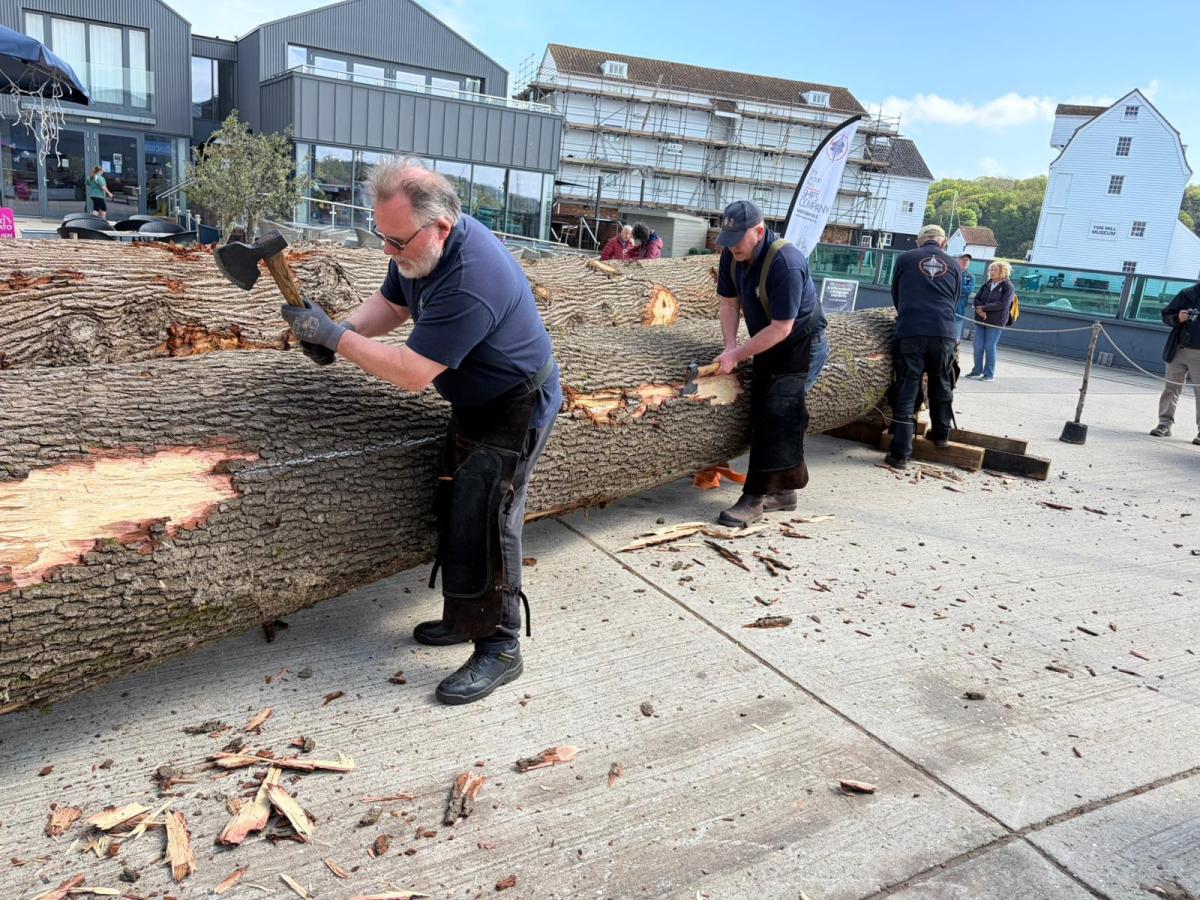
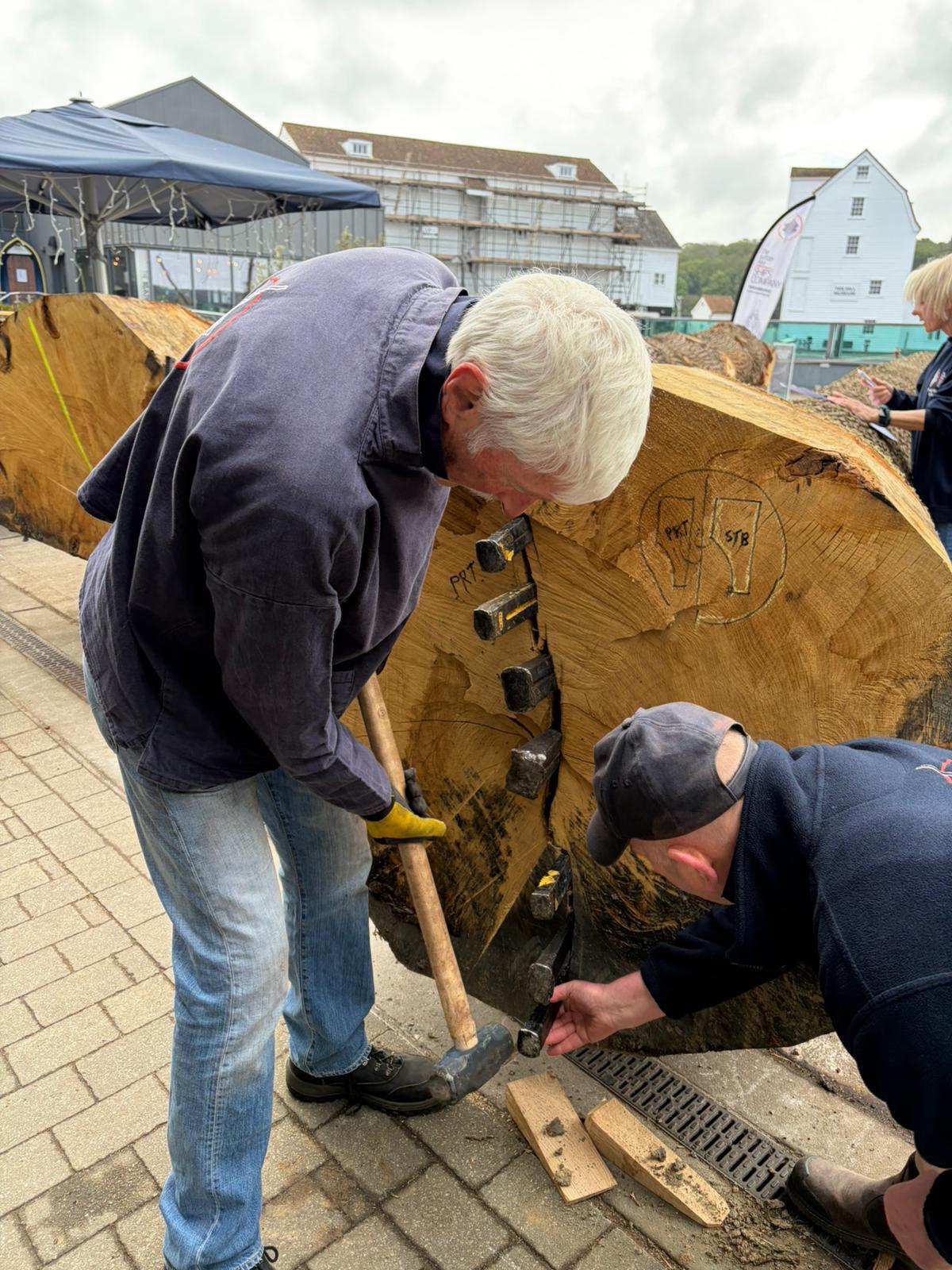

Volunteers creating a replica of the 7th century Sutton Hoo ship have begun cleaving two large oak trees which will form the last part of the vessel's hull.
The two oaks ten metres in length - roughly the same as a London bus - are being worked on by the Sutton Hoo Ships Company (SHSC) outside the Longshed in Woodbridge, where a 90ft copy of the burial ship is being made.
The oaks have been donated to the ship project by landowner Michael Hardcastle, from the Whiligh Estate in East Sussex and are believed to be the longest trunks to be hand cleaved in the UK for many centuries.
The volunteers are using the techniques and tools used by the Anglo Saxons to create the original ship, meaning the work is tough and physical.
The process of cleaving essentially means cutting the logs in half by driving in wedges to split the trunk, but rather than using saws, as would be the case now, the work is being done with hammers and chisels.
The timbers will then be used for the ship's sheer strakes (the top row of planking), with the oars sitting on top.

Jacq Barnard, project manager with the SHSC, said: "This is the last part of the hull.
"We have got to finish off the internal fitting, we have done a lot of the framework.
"Then we need to do the flooring and seating before we can easily row it. There is about another year's work."
The ship is set to be launched in spring 2027.
A crew of about 40 people will be needed to sail the vessel, a copy of the original ship that was discovered by Basil Brown at Sutton Hoo near Woodbridge in 1939.


Share